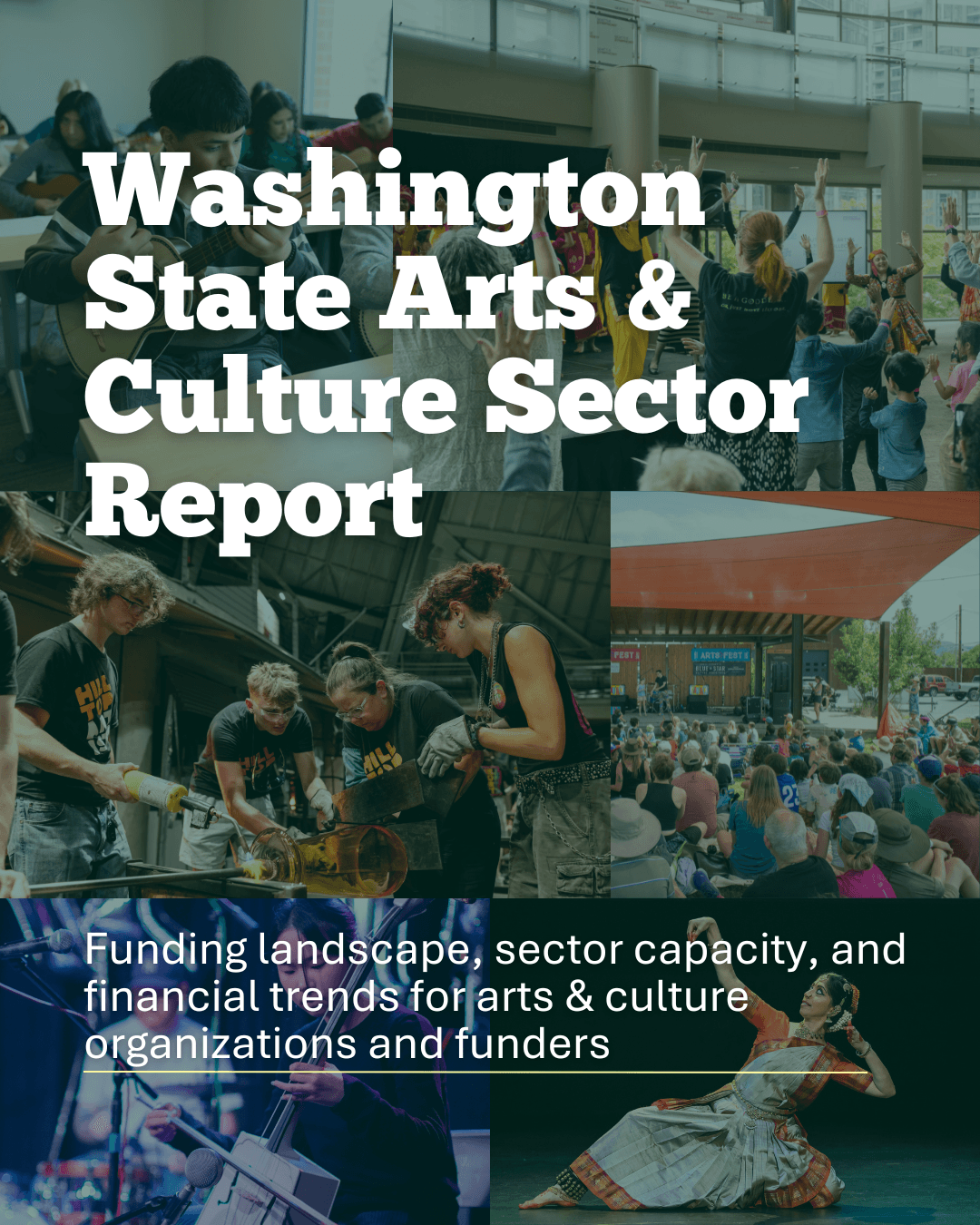
5 key learnings from our Washington arts and culture report
Our report published in September of 2026 explores the arts and culture sector through the multi-year Community Accelerator Grant program, a partnership between ArtsFund and Allen Family Philanthropies, and prepared by SMU DataArts.
1. Small organizations are under the most stress
The report's clearest warning sign is that arts organizations with budgets under $1 million are losing staff capacity while larger organizations continue to grow. Organizations under $1 million lost an average of one staff position between 2023 and 2024, while organizations over $1 million added an average of five positions. Personnel spending also fell most sharply among the smallest organizations. (pg. 31-33)
2. Flexible, unrestricted funding works for arts and culture orgs
Organizations that received multiple years of Community Accelerator Grant (CAG) funding were more likely to grow, diversify revenue, expand programming, and invest in staff. Among organizations receiving three years of funding, 84% grew their budgets over time. The report suggests that consistent unrestricted support helps move organizations from short-term survival toward longer-term sustainability. (pg. 27-28)
3. Grant design determines who gets funded
The report shares that equity outcomes are not accidental. Through low-barrier applications, community-based outreach, and equity-focused award design, CAG significantly increased participation from organizations serving historically underserved communities. By 2025, 84% of grantees centered one or more priority populations, and the number of organizations centering these communities grew 32% over three years. (pg. 19-23)
4. Small grants can be transformational for small organizations
While average grants were only about $10,000-$15,000, they represented a significant share of revenue for many organizations. For organizations with budgets between $25,000 and $50,000, the average grant equaled 29% of annual revenue. Fiscally sponsored organizations received grants averaging 19% of their annual revenue. (pg. 25-26)
5. Much of the sector is largely invisible
One of the most important findings for funders and policymakers is that roughly 70% of Washington arts organizations fall below the IRS Form 990 reporting threshold. That means many small, rural, fiscally sponsored, and community-based organizations are often missing from the datasets used to make funding and policy decisions. The CAG data provides a much fuller picture of who actually makes up Washington's arts and culture ecosystem. (pg. 6, 41)