Tuning In: How distributed acoustic sensing is transforming orca conservation in the PNW
With less than 75 Southern Resident orcas remaining in the Pacific Northwest, studying, understanding, and protecting this endangered population is urgent. Unlike the booming population of transient orcas (also known as Bigg’s whales), Southern Resident orcas face mounting threats – from low food access as salmon populations decrease, to increasing temperatures, pollution, and the noise of maritime traffic disrupting their ability to communicate and hunt.
To better understand their decline and address this crisis, we need new tools, new data, and new methods of listening to the ocean. That’s where Dr. Shima Abadi and her team of researchers at the University of Washington come in.
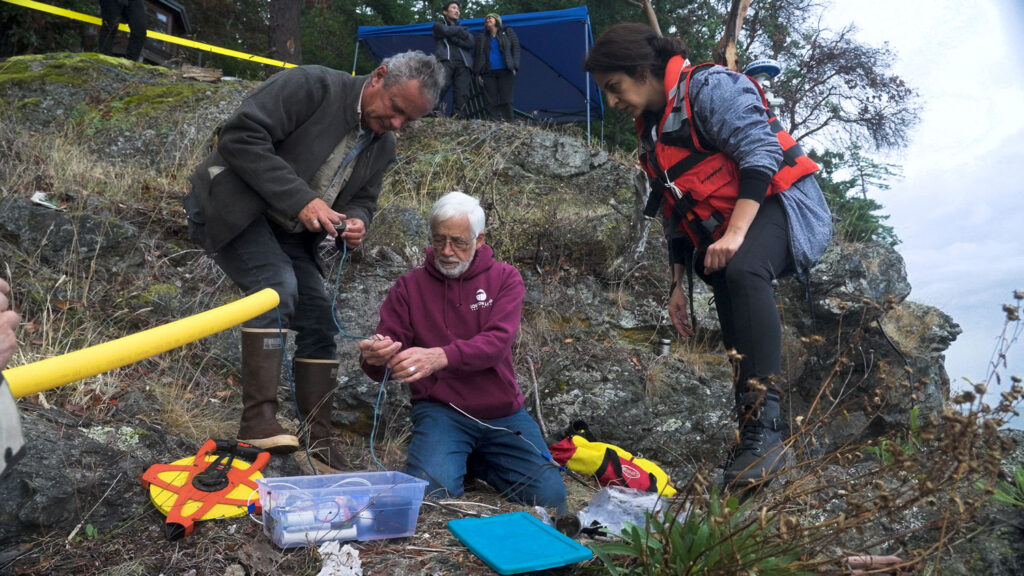
Dr. Abadia, an oceanographer and associate professor at UW Bothell's School of STEM with a joint appointment at UW's School of Oceanography, is leading a pioneering research project centered around acoustic sensing technology, supported in part by Beam Reach, a local nonprofit that contributes comparative data from its existing hydrophone network.
With support from Allen Family Philanthropies, Dr. Abadi’s team is deploying a groundbreaking technology called Distributed Acoustic Sensing, or DAS. This method turns ordinary fiber optic cables on the ocean floor into continuous, highly sensitive listening arrays.
Two kilometers of pre-existing fiber optic cable near Whidbey Island and San Juan Island are being used as underwater receivers capable of picking up sounds from whales along their entire length in real-time. Using existing infrastructure, the cables have the potential to detect orca calls, track movement patterns, and even identify acoustic signatures of nearby vessel traffic.
Researchers then monitor the acoustic data from the sensors, cross-referencing what they hear with location data from Beam Reach’s hydrophone network. This allows the team to better understand where and when the orcas are moving, how they respond to vessel noise, and how shifting ocean climates and conditions may affect their behavior and migration patterns.
This trial led by Dr. Abadi, which launched in 2024, has been generating data that has never been previously collected for Puget Sound’s orca population—and the project has the potential for enormous growth: thousands of kilometers of underwater telecommunications cables are already deployed across the world's oceans, most of them untapped for conservation potential. Using this existing infrastructure as a global monitoring network would give scientists an unprecedented ability to track endangered marine mammals, like Southern Resident orcas across vast distances and in real time.
“This innovative approach could be a breakthrough in conservation efforts and open new possibilities to expand analysis on a much larger temporal and spatial scale,” notes Dr. Abadi.
If this trial proves successful, DAS technology could scale far beyond the San Juan Islands—and make an incredible impact worldwide.